- When we move we're likely to have a much smaller garden - and no doubt I won't be able to commandeer all of it for vegetables, so 'Timely Tips for Small Garden'found recently in a newspaper,may well be very useful:
- Grow Potatoes in pots - we're trying that this year - three sacks in the back garden - and will report back.
- Grow Squash not Pumpkins - or how about courgettes? Perhaps try growing them vertically? Or even remember to only plant the number of plants actually required rather than the whole packet!?
- Grow vertically using wigwams - Cucumbers, Beans. Would any other fruit/veg work with this?
- Buy plug plants if you don’t have a greenhouse - or bring on seeds on a warm windowsill in the house. Again, plug plants are useful to make sure we don't grow too much of anything, it's just so easy to sow the whole of the packet!
- Build and use a coldframe - yes, and must remember to open it in the daytime to avoid 'damping off'.
- Use every scrap of soil you have by planting closer than the book suggest (but remember to use a general purpose fertiliser) - make own compost? Ask local hotels/residential homes for their spare veg peelings? Buy a wormery?
- Plant in rows north to south to minimise over-shadowing - good idea, haven't yet tried this.
- Train fruit onto walls or along wires - espaliers, cordons.
- Only grow what you like to eat - and things which are expensive for supermarkets to transport, such as raspberries and spinach.
- Use hanging baskets for plants such as cherry tomatoes - will try other veg/fruit too . . . such as strawberries, lettuce, peppers? Also nasturtiums as they love to trail and the flowers and leaves are yummy.
Saturday, 12 May 2012

May (May Day (http://projectbritain.com/year/may.htm))
 "A swarm of bees in May

Now I'm back we've just had two busy afternoons at the allotment. It's amazing how the weeds have grown in our absence - a mixture of plenteous rain and sunshine - just what plants (and weeds) love.
 I've spent a lot of time hoeing and weeding, adding the good stuff to the compost heap and putting the 'stroil' aside for drowning and/or burning - and in the process stamped on a legion of snails who've taken up residence in the spinach (see above).


The first broad bean pods are starting to form so have pinched out the succulent broad bean tops. Picked more calabrese, although they are running to flower quicker than we can pick them. The bees love it.
Monday, 28 May: So long since I've written on here but that doesn't mean nothing's happened. We've been up weeding and picking. The spinach has now gone to seed unfortunately, ditto the broccoli which is quite a disappointment as last year we were eating them right through the summer. I put most of that down to neglect with sorting out the house.
Today I picked broad beans and leeks and made a sort of stir fry with some butternut squash, with couscous and lentils, yum.
The front garden on a sunny day:

 "A swarm of bees in May
Is worth a load of hay;
A swarm of bees in June
Is worth a silver spoon;
A swarm of bees in July
Is not worth a fly."
Overwintered Marigolds - - - - -
Overwintered Marigolds - - - - -
12 May: We haven't had opportunity to work at the allotment recently. The month started with bad weather, then when the soil was dry enough we had masses of work to do at the house, getting it ready for viewing by prospective purchasers. Then I went away visiting for a few days.

baby lettuce plants with onion sets behind
 I've spent a lot of time hoeing and weeding, adding the good stuff to the compost heap and putting the 'stroil' aside for drowning and/or burning - and in the process stamped on a legion of snails who've taken up residence in the spinach (see above).

strawberry flower
comfrey plants


potatoes
It's time to sow seeds, in fact rather late for many, but 'better late than never' now the soil's lovely and warm.
This week I've sowed brassicas, tomatoes and aubergines in the greenhouse and will soon plant some peppers. Earlier sweet corn and cucubits were sown inside, along with beetroot and Swiss chard at the allotment. The beetroot and chard have yet to show themselves so must remember not to hoe over their areas by mistake.

shallots
Sunday 13 May: More hoeing and forking over. Planted a row of peas - better late than never, so they say. It's surprising how hard the ground is in some places, even though the soil's pretty moist underneath.The first broad bean pods are starting to form so have pinched out the succulent broad bean tops. Picked more calabrese, although they are running to flower quicker than we can pick them. The bees love it.
Monday, 28 May: So long since I've written on here but that doesn't mean nothing's happened. We've been up weeding and picking. The spinach has now gone to seed unfortunately, ditto the broccoli which is quite a disappointment as last year we were eating them right through the summer. I put most of that down to neglect with sorting out the house.
Today I picked broad beans and leeks and made a sort of stir fry with some butternut squash, with couscous and lentils, yum.
The front garden on a sunny day:

Wednesday, 9 May 2012
I've just returned from a visit to sunny Derbyshire where the temperature was much warmer than a month ago when it snowed, with gale force winds and sleet.

On Sunday afternoon we drove over to Calke Abbey, near Ticknall, for a wander (http://www.nationaltrust.org.uk/calke-abbey/), rather a special place as the National Trust have left the house much as it was. It's not pristine and new like many NT properties but shabby and shows how many grand houses declined over the 20th Century.
However, we didn't go into the house this time - mainly because it was such a nice day and also we hadn't had the foresight to book our time slot. Here are some of the lovely views:

see the deer under the trees ...


beautiful tulips in one of the walled gardens

We also enjoyed seeing the orderly rows of vegetables and herbs and the fruit trees trained in espalier fashion. The grounds of Calke Abbey are so enormous that, although there were hundreds of people around, we didn't feel hemmed in.
Calke Abbey grounds was also hosting a craft market but we didn't fancy queueing to get in and the place looked packed - perhaps next time.
Sunday, 29 April 2012
Euphorbia - or Wood Spurge
I love euphorbias, so much that I'd love to have a whole garden of them, well perhaps even a large area. Why? Well, they're easy, there are one for every area of the garden, they don't require much looking after. Also, once established they provide good ground cover and spread over the years - and there are such wonderful colours.

Here's some information about them which was taken from The Guardian newspaper recently:
"Euphorbia suit every situation from desert to bog, formal courtyard to wild woodland. With one or two exceptions (see below), euphorbia are dead easy. They are also terrific value in the garden, the colourful bracts lasting many weeks.

In fact, this family has only one bad point – an irritant sap that bleeds from the plant when it is snapped. Wear gloves when handling euphorbia, and be careful not to touch your face or get it in your eyes.
 For the Mediterranean patio


http://gardenerstips.co.uk/blog/gardening/euphorbia-euphoria/
http://www.bbc.co.uk/gardening/plants/plant_finder/plant_pages/305.shtml
I love euphorbias, so much that I'd love to have a whole garden of them, well perhaps even a large area. Why? Well, they're easy, there are one for every area of the garden, they don't require much looking after. Also, once established they provide good ground cover and spread over the years - and there are such wonderful colours.
E.Griffithii - one of my favourites
"Euphorbia suit every situation from desert to bog, formal courtyard to wild woodland. With one or two exceptions (see below), euphorbia are dead easy. They are also terrific value in the garden, the colourful bracts lasting many weeks.
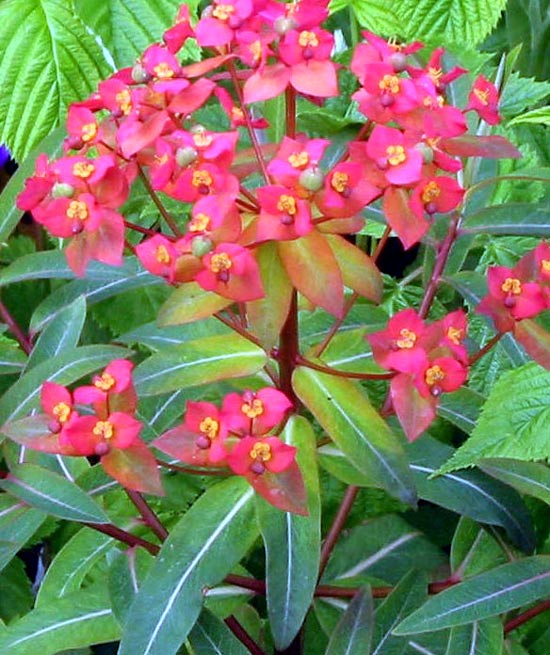
E.Fireglow

The acid lime E. characias and blueish subspecies 'wulfenii' are upright evergreens from the Mediterranean. Both look marvellous with paving – perhaps because so many seem to grow out of solid rock – and equally good in borders. The stems produce foliage the first year, then chunky, yellow-green flowers the following spring. New shoots spring up from the base, so there is fresh growth every year. The species grow up to 5ft tall and wide, and have given rise to many excellent cultivars, includingE. characias 'Lambrook Gold' – hefty, with whopping golden heads (1.2m); E. characias 'Black Pearl' – elegant clumper, with sultry, dark brown eyes (90cm); E. characias 'Portuguese Velvet' – really good form with blue-grey felty leaves (50cm x 75cm); E. characias 'Humpty Dumpty'– dwarf form, 30cm high. Sadly, some of the most handsome forms are short-lived – I have wept to see 'Black Pearl' keel over after five splendid years for no apparent reason – but they seed about when happy, so you'll have another.
For patio pots
Seek out E. 'Diamond Frost' (above), with clouds of airy white flowers and frondy foliage. Usually sold as a bedding annual, it is, in fact, a tender evergreen perennial and can be overwintered in a greenhouse or on a windowsill.
Seek out E. 'Diamond Frost' (above), with clouds of airy white flowers and frondy foliage. Usually sold as a bedding annual, it is, in fact, a tender evergreen perennial and can be overwintered in a greenhouse or on a windowsill.
For the rock/dry garden
All the above thrive in hot, dry sites, but primeval-looking E. myrsinites (below) is a show-stopper, with trailing stems of blue-grey fleshy leaves and lime flowers in spring that turn delicate pink as they fade (10cm, up to 1m spread).
For woodland or dry shade
All forms of E. amygdaloides enjoy shade and humus-rich soil, butE. amygdaloides var. robbiae (30cm), with shiny rosettes of dark green, leathery leaves, romps away in the darkest, driest shade, lighting dark corners with bright lime bracts in spring. For lighter shade, chooseE. 'Whistleberry Garnet', with rounded clumps of red-edged leaves.
All forms of E. amygdaloides enjoy shade and humus-rich soil, butE. amygdaloides var. robbiae (30cm), with shiny rosettes of dark green, leathery leaves, romps away in the darkest, driest shade, lighting dark corners with bright lime bracts in spring. For lighter shade, chooseE. 'Whistleberry Garnet', with rounded clumps of red-edged leaves.
For the bog garden
Though not evergreen, E. griffithii 'Dixter' and 'Fireglow' deserve a place in every garden with damp soil. Dark green leaves are flushed red in spring, then turn red and yellow in autumn, following the brick-red summer flowers. 'Dixter' is smaller and neater (70cm); Fireglow is brighter, especially in full sun.
Though not evergreen, E. griffithii 'Dixter' and 'Fireglow' deserve a place in every garden with damp soil. Dark green leaves are flushed red in spring, then turn red and yellow in autumn, following the brick-red summer flowers. 'Dixter' is smaller and neater (70cm); Fireglow is brighter, especially in full sun.
Big and bold
With gleaming, white-ribbed leaves and huge, fragrant, amber bracts,E. mellifera can reach 2m round, but may be hacked back in spring to new growth produced from the centre. Described as half-hardy, it has survived lows of -12C in my garden. A warm, sheltered corner is ideal.
With gleaming, white-ribbed leaves and huge, fragrant, amber bracts,E. mellifera can reach 2m round, but may be hacked back in spring to new growth produced from the centre. Described as half-hardy, it has survived lows of -12C in my garden. A warm, sheltered corner is ideal.
If you want a purple one...
E. amygdaloides purpurea (below) looks so tempting in the garden centre in spring, with apple-green bracts on plum foliage. Spurn it – it is a martyr to mildew. Likewise, mahogany-coloured E. dulcis 'Chameleon', which is prey to rust. Go for sturdy 'Blackbird' (50cm) with red-black leaves on red stems and orangey bracts from April to June, or 'Redwing' (70cm), which flowers earlier and longer, over purple-flushed leaves that darken in winter.
 Aftercare
E. amygdaloides purpurea (below) looks so tempting in the garden centre in spring, with apple-green bracts on plum foliage. Spurn it – it is a martyr to mildew. Likewise, mahogany-coloured E. dulcis 'Chameleon', which is prey to rust. Go for sturdy 'Blackbird' (50cm) with red-black leaves on red stems and orangey bracts from April to June, or 'Redwing' (70cm), which flowers earlier and longer, over purple-flushed leaves that darken in winter.

Euphorbia look best if allowed to sprawl at will, but if space is limited, you may need to support the floppier ones. The evergreens require no routine pruning – simply tidy them up when they start to look tatty. Deciduous ones should be cut down to ground level in autumn. New shoots will emerge from the crown in spring. The biennial forms such asE. characias produce new shoots from the base each year. Cut out dead stems in winter. They are not fussy as to soil, but most prefer good drainage.
They grow well with...
The bigger, more sculptural forms look good with architecture – against steps or walls, or in corners of courtyards. E. mellifera is a superb statement plant. I grow E. myrsinites in a river bed garden with E.'Redwing', golden Libertia peregrinans and blue and gold grasses. E. griffithii 'Fireglow' looks marvellous beside water, with bronzy rodgerias and red-flushed astilbes, but will serve in any hot border, while E. 'Whistleberry Garnet' associates well with ferns, hostas and the dark-patterned leaves of Geranium phaeum."
The bigger, more sculptural forms look good with architecture – against steps or walls, or in corners of courtyards. E. mellifera is a superb statement plant. I grow E. myrsinites in a river bed garden with E.'Redwing', golden Libertia peregrinans and blue and gold grasses. E. griffithii 'Fireglow' looks marvellous beside water, with bronzy rodgerias and red-flushed astilbes, but will serve in any hot border, while E. 'Whistleberry Garnet' associates well with ferns, hostas and the dark-patterned leaves of Geranium phaeum."
http://gardenerstips.co.uk/blog/gardening/euphorbia-euphoria/
http://www.bbc.co.uk/gardening/plants/plant_finder/plant_pages/305.shtml
Carrot and Cheese Pasta Bake

4 medium leeks, sliced
1 kg carrots, grated
6 cloves garlic
1 cup fresh basil
8 eggs, lightly beaten
100ml milk
400ml double cream
Seasoning
12 sheets instant pasta (500g pasta shapes)
350g grated cheese, plus 50g Parmesan for the top
* http://www.onlineconversion.com/cooking_gasmark.htm
4 medium leeks, sliced
1 kg carrots, grated
6 cloves garlic
1 cup fresh basil
8 eggs, lightly beaten
100ml milk
400ml double cream
Seasoning
12 sheets instant pasta (500g pasta shapes)
350g grated cheese, plus 50g Parmesan for the top
- Par boil leeks and garlic.
- Add carrots and cook 20 mins
- Drain, reserving stock.
- Combine cream eggs, pepper, add a little stock.
- Cover base of dish with half pasta, then half mixture, half cheese, rest of pasta, rest of mixture, top with cheese.
- Pour the egg mixture over
- Cook 170C* for about 40 mins
- Serves 10.
Vegetable Lasagne
4 oz butter
4 oz flour
2 tins tomatoes
1 onion
1 pepper
cucubits
herbs, pepper
2 tsp mustard
8 oz grated cheese
20 sheets lasagne
Serves 10
* http://www.onlineconversion.com/cooking_gasmark.htm
Saturday, 28 April 2012

So it is Mr van Houten we have to thank for the base of this luscious pudding . . . CHOCOLATE . . .

Chocolate Pots
250g milk
250g double cream
1tsp good quality cocoa powder
7 oz dark chocolate
1/2 stick cinnamon
1/2 vanilla pod
6 egg yolks
To serve:
spiced biscuits or biscotti
- Heat cream and milk with cinnamon stick and vanilla pod until it boils.
- Pour mixture onto the egg yolks and whisk until all is combined.
- Strain through a fine sieve.
- Pour onto the chocolate and mix well.
- Divide the mix into 9 small pots or ramekins and place in roasting tray.
- Add boiling water so it reaches halfway up the dishes.
- Cook at 130C for 40 minutes
- Remove from the oven and cool in the fridge for at least five hours.
- Serve with spiced biscuits

Thank you to Mark Tilling, Chocolate Master 2008, for the recipe, see: http://www.telegraph.co.uk/foodanddrink/recipes/4435415/Chocolate-recipes.html
Wednesday, 25 April 2012
My Honey Lemon Chicken recipe

6 skinless chicken thighs
1 oz butter
3 fl oz lemon juice
1/2 lemon, sliced into
4 oz honey
4 sprigs rosemary
2 medium onion
20 small pieces of potato
Chicken stock cube, dissolved in water
Method:

6 skinless chicken thighs
1 oz butter
3 fl oz lemon juice
1/2 lemon, sliced into
4 oz honey
4 sprigs rosemary
2 medium onion
20 small pieces of potato
Chicken stock cube, dissolved in water
Method:
- In large pan brown chicken pieces, add onions and cook.
- Add lemon slices, rosemary, potatoes, pepper. Mix together the honey and lemon juice and pour over the top.
- Pour in stock one third up the side of the tin. Put on lid or tinfoil.
- Cook at 170 for an hour, remove lid and cook another twenty minutes or so.
Serves 6
Subscribe to:
Posts (Atom)