Friday, 23 November 2012


Elizabethan Pork


4lb pork, cubed, cooked with 8 tbsp oil
1 lb onions (sliced), 6 garlic cloves
2½ oz flour, 1.5 pts red wine
½ - 1 pint cold water (add at end to cool down before putting in fridge)
2 level tsp mace
2 level tsp medium hot curry powder
½ level tsp cayenne
2 level tsp celery seeds
2 sprigs - marjoram, thyme, sage, rosemary - or more
8 oz stoned ready to eat apricots
8 oz large stoned raisins
8oz large stoned semi dried dates
Finely grated rind and juice 2 lemons
4 small dessert apples, thickly sliced, put into juice of 2 oranges
4 level tsp soft light brown sugar
To garnish: 4 oz walnut halves

  1. Brown pork in oil in frying pan, in batches, then in same pan
  2. brown onions, add flour, wine, then garlic, mace, curry powder, cayenne pepper, celery seeds, s&p. Add herbs, together with apricots, raisins, dates, lemon rind and juice and orange (juice only).
  3. Put pork and sauce into casserole and cook 2 hours, stirring occasionally.
  4. Serve garnished with marjoram sprigs, walnut halves and orange strips.
  5. Serves 13
Also see: http://www.elizabethan.org/compendium/46.html

Pudding time ...

Nostalgia Pudding 
(from Jocelyn Dimbleby)

8 oz butter
12 oz apricot jam
4 tbsp lemon juice
10 oz breadcrumbs
2 oz SR
5 oz caster sugar
6 eggs
1 tsp bicarb
4 oz chocolate

  1. Measure out dry ingredients - breadcrumbs, sr, sugar, bicarb.
  2. Melt butter and jam in saucepan.
  3. Add lemon juice, pour over dry ingredients,
  4. Add eggs, mix.
  5. Add chocolate.
  6. Put into dishes
  7. Serves 14

Apple & Apricot Crumble

Med sq round cooked apple
6 apricots, chopped
2 ozs demerara sugar
1/2 tsp cinnamon
1/4 tsp nutmeg
4 oz butter
4 oz margarine
5 oz white flour
3 oz wholemeal flour
6 oz demerara sugar
cook at 180 for 30-40 mins
serves about 6


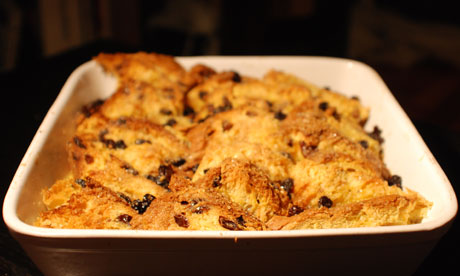
APRICOT BREAD AND BUTTER PUDDING

18 thin slices white bread, crusts removed
5 oz butter
10 oz chopped apricots
20 fl oz double cream
32 fl oz milk
8 big eggs (or 4 egg yolks and 4 eggs)
4.5 oz caster sugar
1.5 tsp vanilla

  1. Preheat oven to 170/190 (5). Spread butter onto bread and cut each slice into 4 triangles. Arrange 9 slices of bread over base of tin. Sprinkle over the apricots, then arrange remaining bread triangles on top.
  2. Mix cream, milk, eggs, vanilla and sugar together and sieve. Pour over bread and leave to soak 5 mins.
  3. Put dish into roasting tin and pour hot water half way up the sides.
  4. Bake in high oven for about 30 mins, until top is golden and custard is lightly set but soft in centre.
  5. Remove from tin, cool about 15 mins.
  6. Serve with cream or ice cream
  7. Serves 18


Some recipes using beef

AUSTRALIAN BEEF HOT-POT

3 lb chuck steak
1 apple, diced
2 tsp medium curry powder
1 tbsp garam masala
1 tin chopped tomatoes
4 oz raisins
1 pt beef stock
2 level tsp brown sugar
4 tbsp oil
4 medium onions, sliced
2 level tbsp flour
s&p
1 tsp tomato puree
1 tsp mixed herbs, chopped parsley


  1. Cut meat into 3 cm squares, brown in oil, add onions, apple, curry powder. Saute a few minutes.
  2. Stir in tomatoes, raisins, flour, stock s&p and sugar.
  3. Simmer, covered, about 1 hr, until meat is tender, sprinkle in herbs and gm.
  4. Garnish with parsley.
  5. Serves 12

BEEF IN RED WINE

3tbsp oil
3 cloves garlic
13oz streaky bacon chopped
4 lbs stewing beef
5 tbsp flour
16fl oz red wine
½ water
3 bay leaves
20 tiny onions (pieces of onion)


  1. Cook bacon and garlic in oil and butter, add beef and brown.
  2. Add flour and wine, then bay leaves, pepper and onions.
  3. Cook for ages, add ½ pint water if necessary.
  4. Serves 14 - 16


Flemish Beef in Beer
3 kg chuck steak or thick flank, 3 tbsp oil
21 oz button onions
3 level tbsp flour
½ pt orange juice, rind of an orange,
½ pt water
1 ½ pt pale ale
3 sprigs rosemary
3 pinches grated nutmeg

  1. Brown onions, put aside. Brown meat, add onions, Stir in flour.
  2. Add orange rind and juice, water and ale, stir well. Add rosemary and nutmeg, season.
  3. Bring to boil, stirring, transfer to casserole, cover and cook in oven at 170C for 2 hours.
  4. Serve with potato.
  5. Serves 18 - 20.

COTTAGE PIE - Serves 4

l lb cooked minced beef
2 medium onions, chopped
1 large carrot, diced
1 level tbsp flour
1/2 tsp herbs
1/2 tsp cinnamon
1 tbsp parsley
1/2 pt hot beef stock
1 tbsp tomato puree
s&p, oil
Topping: 2lb potatoes
1 medium leeks, chopped
2 oz butter
S&p
Fry onions in oil, add carrot and mince, cook 45 mins.
Season add herbs, cinnamon and parsley.
Stir in flour, add tomato puree and stock, cook a few mins.
Cook at 200C (Gas 6) about 25 minutes.


BOLOGNESE SAUCE (from Delia)

12 oz lean mince
6 oz chicken livers, chopped
4 rashers unsmoked bacon, chopped
2 tsp dried basil
1 onion, finely chopped
2 cl garlic
14 oz tin tomatoes
8 tbsp red wine
4 heaped tbsp tomato puree
3 tbsp olive oil
Heat oil, soften onion, bacon and garlic. Turn heat up add chicken livers mince and brown. Pour in tomatoes, tomato puree, wine basil, season. Simmer with lid on for 20 mins, then with lid off for 20 mins.


Beef and Bean Chilli

1 small red pepper, chopped
1/2 small fresh red chilli, chopped
1 medium onion, chopped
2 tbsp oil
1 lb minced beef
1 level tsp paprika
1 tbsp ground cumin
3 cloves garlic
400g chopped tomatoes
1 tsp tomato puree
1 tsp dried oregano
125ml/4 fl oz red wine or beef stock
salt
1/2 tsp sugar
400g canned kidney beans
Serves 5

  1. Heat oil in large pan, fry pepper, onion, beef, paprika, cumin over moderate heat, stirring, until meat browns.
  2. Add garlic, chilli, canned tomatoes and juice, tomato puree, oregano, wine or stock, salt and sugar. Cover, simmer 15 mins.
  3. Add kidney beans, cook 5 mins and then serve.


Wednesday, 14 November 2012

Italian Cookery classes with Giovanni Butto, Autumn 2012

Week 1 

Petto di Pollo al Proscuitto Crudo


(Serves 4)

4 Chicken breasts
1 Aubergine
1 Red pepper
8 slices Parma Ham
1 bunch of Rosemary
2 fresh Fennel
Parmesan
Butter
s&p
Olive oil
  1. Heat oven to 180C
  2. Slice aubergine into 8.
  3. Gill aubergine and red pepper and put to one side.
  4. Remove skin from red pepper and cut into 8 suitably-shaped pieces
  5. Make an open pocket in each chicken piece
  6. Lay two slices of aubergine and red pepper on one half,
  7. Season and add a sprig of rosemary, fold up
  8. Wrap two slices of Parma ham around the chicken piece
  9. Fry in pan on stove on both sides in some olive oil
  10. Put in oven in lidded pan for about 20 mins.
  11. Remove from dish
  12. Make sauce by adding white wine or brandy, some cream and some mushrooms or a make a tomato sauce

to accompany
Fennel:
Halve fennel pieces
Boil until tender
Place on buttered dish
Put parmesan on top, dot with butter
Grill until golden


Idea for cooking pheasant:
  1. Debone and portion pheasant.
  2. Fry pieces gently in some olive oil
  3. In another pan add smoked, chopped pancetta to olive oil, add chopped red onion.
  4. Add halved red grapes and some white wine.
  5. Cook, then whizz.
  6. Return to pan, add some double cream and a little more wine.
  7. Put pheasant pieces on serving dish and pour sauce over the top
  8. Garnish with some red grapes.

Week 2

Filetti di Trota agli Spinaci e Prosciutto Crudo

4 Trout fillets
8 slices Parma ham
1 bag spinach
Dolaelatte
1 cloves Garlic
1 tsp ground Coriander
1 tsp ground Nutmeg
1/2 Fish stock cube
s&p
Flour
Olive oil
Butter
1 glass White Wine
pack of Oyster Mushrooms
  1. Cook spinach, drain and squeeze thoroughly.
  2. In a small sauce pan brown chopped garlic add spinach, coriander, nutmeg and s&p.
  3. Put on one side to cool
  4. Remove skin and bones from trout fillets
  5. Place the parma ham on table and put trout fillets on top, skin side up, s&p
  6. Divide spinach equally between the fillets, top with small amount of Dolcelatte and roll up into parcels.
  7. Place in fridge to rest for about 5 minutes
  8. Light dust the trout parcels with flour
  9. In a pan, place a small amount of oil and butter, brown fish parcels on all sides
  10. Add white wine and a small amount of fish stock, thicken the sauce (possibly with butter)
  11. Cover and simmer for about 10 minutes.
Sauce for Trout
Onion, mushrooms, lemon juice, stock, butter, olive oil.

Pilau Rice

500g rice
200g peas
1 red onion
1.2 litres stock
  1. Fry onion in some olive oil
  2. Add rice
  3. Add peas
  4. Gradually add stock
  5. Cover and cook for 20 minutes in oven

Broccoli and Carrot Cake

Pastry300g strong flour and 125g butter
3 eggs
4 tbsp milk
2 tbsp cream
75g grated emmental


  1. Par-cook broccoli, carrots and red onion.
  2. Wisk together the rest of the ingredients.
  3. Line dish with pastry, put in vegetables.
  4. Add egg mixture
  5. Cook about 45 mins at 180C.


Week 3

Agnello a Modo Mio

1 kg leg of lamb, cut into pieces
Olive Oil and Butter
2 Egg yolks
20 small Shallots
Bouquet garni
200g fresh Mushrooms
50g dried Mushrooms
1 small carton Double Cream
Beef/Lamb stock cube made up to 1/2 litre
Flour, s&p
glass of White Wine
  1. Soften dried mushrooms in warm water.
  2. In pan put butter and oil and well brown lamb pieces in batches, adding salt and pepper.
  3. Add a small amount of flour to thicken, then add stock and white wine.
  4. Add shallots, chopped mushrooms and the bg
  5. Cover and cook on a low heat for 45 minutes until the meat is cooked.
  6. Remove meat from the pan and keep in a warm place.
  7. Remove the bg.
  8. Mix cream and beaten egg yolks and add to the sauce.
  9. Heat without boiling, return meat and stir well.

Stuffed Cabbage

Olive oil and Butter
10 Cabbage leaves
Red onion
50g Sausage Meat
250g Beef mince
Coriander, parsley or other herbs
A glass of Milk
Lemon zest
S&p, garlic
Egg yolk
Parmesan cheese
String

Par-cook cabbage leaves and refresh
Chop onion and brown in oil and butter
Add mince, brown, then add sausage meat, herbs
Add milk, s&p and lemon zest
Cool a little
Add egg yolk and parmesan
Lay out cabbage leaves, divide mixture between them
Nip stalk near bottom, roll up the leaves (like fish & chips parcels)
Tie with string lengthwise
In pan put oil, butter and chopped garlic
Add cabbage parcels, some salt and brown them.
Remove and put in ovenproof dish
Put tomato-ey sauce on top and sprinkle with parmesan.
Cook in oven for about half an hour.

White Cabbage Salad

Slice white cabbage finely, add salt, vinegar, lots of lemon juice and mix thoroughly.

Pestogarlic, pine nuts, basil, oil, parmesan, pecorini, s&p.

Pasta: 100g strong flour, 3 eggs. Stir, mix, knead.

Tried and Tested - Widgets that Work

With Christmas a-coming, Liz Dobbs from The Telegraph picks some ingenious gadgets and handy tools that make everyday gardening tasks a bit easier.


Tomato turns: these galvanised steel spirals supported our cordon tomatoes in the greenhouse this year without theneed to tying in - the stems grew up within the spiral shape. By Bosmere, from garden centres. See: http://www.alibaba.com/showroom/steel-tomato-spiral-rod.html

Fleece preservers: Crop covers such as garden fleece need to be secured to the ground to be effective but pegging them down invariably means the fabric gets torn.  These nifty clips are an alternative that will extend the life of your crop covers.  Simply slip them on along the edge of the fabric and you will then have a row of eyelets to push the pegs into.  Various quantities are available, with and without pegs, from £5.49 for 10 (gardening-naturally.com)

It's a wrap: Rather than wrestle with sheets of fleece and string when insulating borderline hardy shrubs or container specimens, use garden fleece plant jackets with a drawstring or zip.  Then just put over the plant, pack with any other insulation and pull the string or zip up.  Haxnicks has a good range with a drawstring and toggle, widely availale in garden centres, while Harrod Horticultural sells zipped fleeces online.
Draper 43973 150mm Soft Grip Pointing Trowel
Something borrowed: A pointing trowel, designed for pointing brickwork, makes a precise, yet versatile and lightweight, garden tool.  Use the pointed tip to remove weeds between plants and to make short seed drills.  The edge of the blade will quickly skim the soil surface to clear small annual weeds prior to planting; the actual trowel is suitable for planting small plants or bulbs. 

App alternative: This planting wheel, £5.25, is a handy memory jogger for more than 30 veg.  Turn to the veg in queestion and it will remind you when to sow or plant, how deep and how far apart. It wipes clean and there's even a hook to hang it up in your garden shed (http://www.marshalls-seeds.co.uk/planting-wheel-and-grow-your-own-vegetables-book-pid5386.html).

Strong and hairy: Coir string, used by hop growers, has a fibrous texture so is effective as a vetical support for cucumber plants.  It also blends in well when used as a plant tie in the garden.  A 500g hank of hop twine can be bought by mail order from Baileys Home & Garden for £6.50 plus £4.50p&p (call 01989 563015 or email sales@baileyshome.com as it isn't on their website.


Wigwams without ties: This simple piece of plastic was recommended to me by an elderly neighbour as an easy way to make a wigwam for sweet peas.  You just push the bamboo canes into the slots, rather than having to tie them together.  The Tenax version, about £3 to £5, is made of soft plastic so is malleable enough to take the canes. From garden centres and tenax.co.uk.


Tension without stress: Training wires for climbers, supporting vines or canes need to be really taut to do their job.  In the past that meant twisting the ends of wires with pliers but now the Gripple takes the sdtrain - you simply poke the nylon wire down the holes as instructed.  Can be used for grapevines, raspberry canes or ornamental climbers against walls.  To understand how it works, there's a good video on gripplegarden.com, where you can buy direct (a starter pack of four Gripples, 100'/30m of nylon wire and four vine eyes is £16.79). 


Welly neat: Wellitop, £5, is a novel device that fits into the top of a pair of Wellingtons, keeping the boots together and upright (as well as free from spiders).  There is a carrying handle so you can move boots around easily and a cord to hand them up (neatideasdirect.co.uk).


Go digital: An essential bit of kit for a greenhouse, a max/min thermometer shows you the maximum and minimum temperature.  I prefer digital ones as they are easier to read. Some also have a weather station which measures humidity as well.

Hairy pots:  These pots are made of coir and you plant both the pot and the plant - the roots grow through the pot and eventually the coir rots down into the soil.  Apparently, they're brilliant for sowing plants into the ground but the pots are rather bulky for planting plants into containers, such as herb gardens.  Coir pots and accessories can be obtained from hairypotplants.co.uk.

Name that plant:  Using the Brother labelling kit is invaluable.  The printed labels are easier to read than handwritten ones and can be reused.  These can be stuck onto colour-coded plastic laels (depending whether they are destined for: the allotment, greenhouse or garden).  For large quantities of coloured labels, try lbsgardenwarehouse.co.uk.  The Brother GL-200 Garden Labelling Kit with 50 white labels, £47 (labelzone.co.uk)
Rotary Soil Sieve
Take a turn: A sturdy rotary soil seive will sift soil (or garden compost or other organic matter), andmake it physically more suitable as an ingredient in a potting mix.  The sieve is fairly hard work to use, as you need to turn the handle to push the material through, but setting the device over a wheelbarrow helps to keep it steady and collects the sifted material.  Prices vary, the best seen is £34 plus £5.45 p&p (http://www.recycleworks.co.uk/soil-sieves-sifters-c-259.html). (To initially seive home-made compost I use an old freezer basket, chucking the bits which won't go through straight back into the composter for another day).

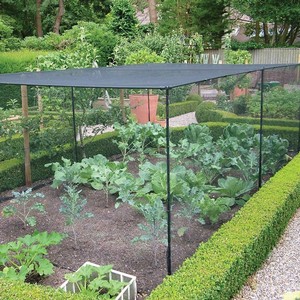
Harrod Slot & Lock® Black Coated Aluminium Vegetable Cage (1.5m H)A stronger support:  The new Harrod Slot & Lock system has locking screws to hold aluminium tubes firmly in place so you can build sturdy cages to support net covers. The cage is quick to assemble, easy to move around raised beds, and strong.  The optional extra of a slip-on butterfly net cover is a real time saver, it pulls over the cage in an instant and fits snugly.  The system comes in a range of sizes, the smallest (4ft x ft/1.2m x 1.2m) is £22.95 for the frame, £33.90 with the slip-on net (harrodhorticultural.com).

Scratch and scrape: After testing more than 30 hand-weeding tools, the Burgon & Ball stainless steel weeding finger , £8.95, emerges as the favourite.  Lightweight but effective, the side of the curved blade can be used to scrape off moss from brick walls and decking, while the tip is perfect for scratching out weeds in awkward rockery crevices and from between paving slabs (http://www.burgonandball.com/shop/scripts/prodView.asp?idproduct=83)


Also this looks an interesting site: http://gardening.jen99.com/ (no relation)
5th - 9th November was National Sausage Week* but I, along with most of the country, was busy enjoying Bonfire Night (about the 5th) and honouring the fallen on Remembrance Sunday (this year it actually fell on 11.11). 

So now, only one week late, it's time to celebrate one of Britain's favourite foods.  As a nation we spent more than £707million on sausages last year and we've been eating them for a very long time.

Sausages were brought to Britain by the Romans in around 400AD so sausage eating predates by a very long way our national dishes of fish & chips and curry+.  The dates at which these dishes became popular is a whole other story.

To celebrate the humble sausage sandwich, here's a Yorkshire recipe for this often-thought-of-as-humble delicacy:

  1. Cook the sausages (fried, grilled or oven cooked) the more cooked the better so far as I'm concerned
  2. Split the sausage(s) in half lengthwise and lay on the bottom of a Yorkshire tea cake (also known as large roll/bap/cob) cut in half.
  3. The top half should then be fried in the bacon fat until crisp and tasty.
  4. Dip into reduced chopped tinned tomatoes
  5. Carefully lay on the of the sausage.
  6. Serve, perhaps with brown sauce.

Incidentally, I'd never even heard of a sausage sandwich 'til I worked for BBC Local Radio in the mid 1980s.  It's what kept the journalists going when they were busy on a 'story'.

Other good ways to eat sausages include:
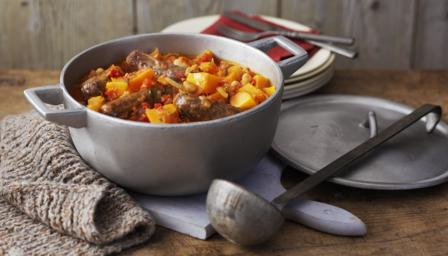
  • Sausage casserole with plenty of vegetables, beans, possibly with a scone mix on top, a cobbler-type of dish.  Here's a colourful version, complete with seasonal pumpkin.
  • Toad in the Hole, with the best Yorkshire pudding batter recipe (On from our very own Delia: http://www.deliaonline.com/recipes/cuisine/european/english/toad-in-the-hole-with-roasted-onion-gravy.html)


*http://www.lovepork.co.uk/blog/article/sausage-week-2012

From an article by Brian Turner, Chef

+ Fish & Chips and Curry House, rather surprisingly the curry house came first:

  • Fish and chips is a popular take-away food that originated in the United Kingdom in 1858 or 1863. In 1860, the first fish and chip shop was opened in London by Jewish proprietor Joseph Malin.
  • The first curry house was more like 1809, see: http://news.bbc.co.uk/1/hi/8370054.stm

Saturday, 10 November 2012

Was the rainy summer really so bad?  Let's count our blessings

How was it for you, the summer of 2012?

Gardeners tend to take stock around this time of year and there have been many moans about the terrible weather, but thinking back, it wasn't all bad.  Trees and shrubs planted have never done so well, or worried us so little.

Buying expensive plants and getting them through their first season can be nerve-racking.  


Crocosmia
It was not just trees and shrubs that thrived.  Perennials were amazing.  Huge crocosmia, outsize and flourishing phlox, brilliant aconitum - all plants that I sometimes think I should forego on my thin stony soil, but this year they were in peak condition.  


It's been agreed that it's been a wonderful year for everything - bar annuals and vegetables.

According to a representative of the RHS, the reason why 2012 was so bad for annuals (which include vegetables) and had been disappointing was because conditions for sowing in March were ideal, but April and May were too cold for seedlings to grow and annuals need to make a lot of leaf cover by June to thrive.  The light levels stayed low and leaves were too small to gather any sunlight under the dense cloud cover.

Unfortunately, all the soft growth made this summer would be less weather-resistant if we have a hard winter.  In Philadelphia a shrub will survive much colder weather than here.  Is this because they have such long hot summers?  Hardiness is a complicated subject and it is true that weather in the summer can markedly alter the hardiness of plants.  But the most worrying weather would be a very mild October, followed by severe winter frosts after Christmas, but there's not much we can do about this.   After all, gardening isn't a precise science.

The  gardeners' year starts here in the autumn, with what used to be called the 'back end'.  January is too late for resolutions.  

Although many people dread November, all soggy leaves and brown stems.  It's the time to start looking forrward to the next gardening year.
Next year's bounty from the garden!

Aready it's time for us to plan how next season might be better than this year.  We can't beat the weather and I do hope there'll be more fruit and fewer slugs in 2013.  

But on the whole most seasons have their compensations, even ones like the non-summer of 2012, which has been given the thumbs down by everyone we meet.